 English
 Русский
 عربي
 Español
 Français
 Português


GR Flexible Pavement Completes Heavy-Load Limit Verification at a Mongolian Gobi Mine
Sep 28, 2026
In the Gobi desert of Mongolia, a completed high-grade coal haul road serving the Haolaitala open-pit coal mine has recently undergone a deliberately designed heavy-load limit verification. Unlike a conventional handover acceptance, the programme did not simply run through an established procedure: a section of completed pavement was selected and subjected to staged heavy-load cyclic trafficking until structural distress appeared, in order to establish its true load-bearing boundary.
The verification was executed on site by China Railway No.4 Engineering Group, with the test programme defined by the design institute, and every step was carried out in accordance with industry standards with traceable records. The results were ultimately acknowledged as satisfactory by the owner, the designer and the contractor alike.
The emphasis of this work lies not merely in a “pass” result, but in the completeness and complexity of the test design itself — bringing the full range of demanding conditions a thin-layer surface may encounter on a real mine road into a single systematic verification.
1. Baseline first: full documentation of the initial condition
Before loading began, a comprehensive initial-condition survey of the test section was carried out and documented item by item, to serve as the baseline for later comparison:
Pavement thickness — measured station by station, with deviations controlled within the permitted range;
Compaction — determined by the sand replacement method;
Initial roughness — recording the ride quality of the surface before loading;
Initial rebound modulus — recording the initial load-bearing capacity of the pavement structure;
Initial surface condition — a full survey for any pre-existing defects.
Only after confirming that the section had no pre-existing defects and met the conditions for testing was loading permitted to proceed — so that the subsequent data reflect the true effect of this loading, rather than any existing weakness.
2. Staged loading and limit loading: two tracks in parallel
The verification adopted a dual-track loading design, capturing both a “performance curve” and the “load-bearing limit”:
The first track — staged loading. Trafficking was applied in successive stages, with cumulative passes increased level by level and a measurement taken after the completion of each stage. Immediately after every stage, the test vehicle was withdrawn from the test section and the surface allowed to rest before measurement, so that instantaneous stress during trafficking would not interfere with the readings.
The second track — limit loading. On the basis of staged loading, trafficking continued until clear structural distress appeared, with the number of passes to failure recorded, on which the heavy-load fatigue performance of the thin-layer surface was assessed.
Running in parallel, the two tracks reveal both the performance curve under each load level and the more fundamental question of how far the surface can actually be pushed.
3. Monitoring layout: sub-sections, multiple stations, multiple points
To reduce random error and enable lateral comparison between sub-sections, the test road was divided evenly into several sub-sections, each with identical operating conditions and construction technique.
Standard test stations were set at equal intervals within each sub-section;
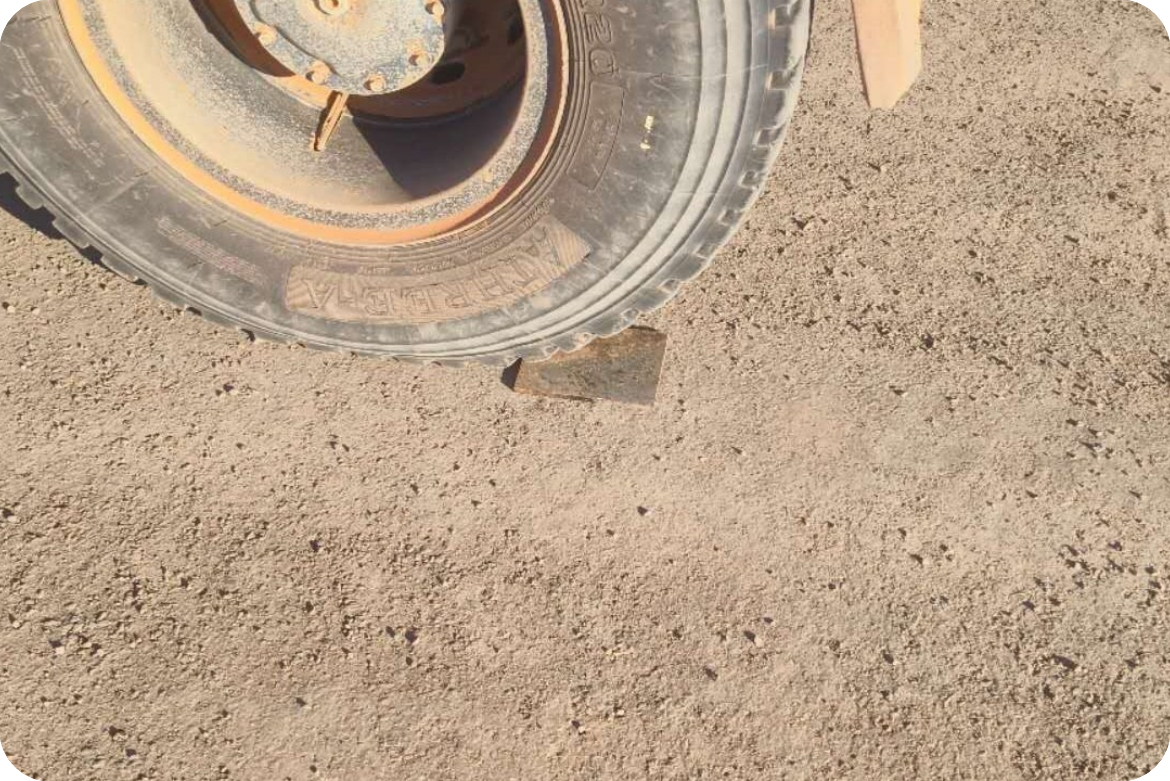
At every station, three positions were monitored — left wheel path, right wheel path and centre — precisely the core load-bearing zones of heavy-vehicle wheel paths;
All points were marked and numbered in advance, and during trafficking the fixed points were measured repeatedly, ensuring that data remained comparable and the deterioration process traceable.
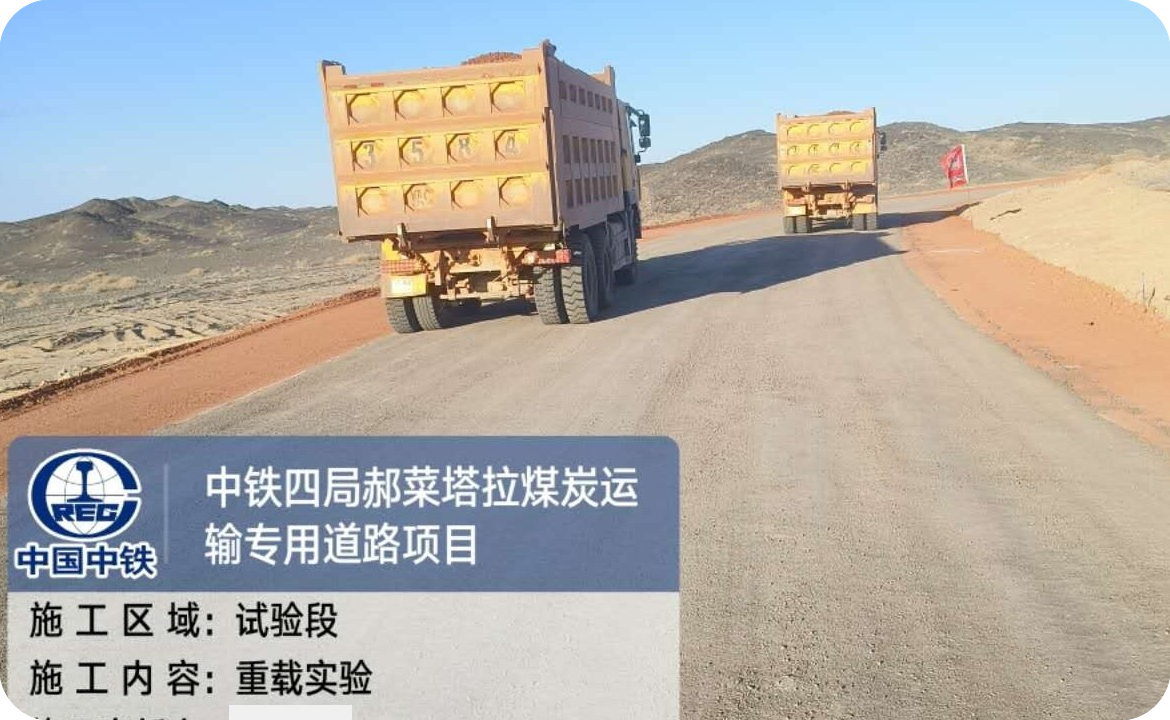
Strict requirements on the driving pattern: the test vehicle ran the loaded lane at a constant slow speed, back and forth, so that every pass fell on the same track — no lane changes, no shortcuts. Turning on the road surface was strictly prohibited; the vehicle had to leave the pavement and turn on a dedicated area, so that incidental damage would not affect the accuracy of the test data.
4. Detection dimensions: five indicators measured in one campaign
Before and after each load stage, data were recorded point by point and station by station across the following five dimensions, with photographs and video captured throughout:
1.Rutting — maximum depression in the wheel path, recording the deformation increment at each load level;
2.Roughness — the attenuation of roughness, analysing the pattern of change in ride quality;
3.Settlement — both overall settlement and local uneven settlement;
4.Rebound modulus — the change in structural load-bearing capacity under repeated heavy loading;
5.Surface distress — cracking, sanding, peeling, loosening and potholing, each recorded by location, size and development trend.
Covering all five indicators in one campaign is intended to fully reflect the deterioration of the pavement, without missing any weakening signal.
5. Three points underpinning the credibility of the data
The conclusions of this verification hold up to scrutiny on three counts of credibility:
Credible environment — the verification took place on a real Gobi mine coal haul road: arid, windy, with wide day-to-night temperature swings and a sandy, unevenly bearing subgrade — not idealised indoor conditions;
Credible process — sub-sections, stations, monitoring points, staged loading and limit loading were each established item by item, with a standard basis and original records for every step;
Credible participants — on-site execution by China Railway No.4 Engineering Group and a test programme defined by the design institute, with independent professional involvement reinforcing the authority of the conclusions.
6. Conclusion and significance
Through staged and limit loading, the thin-layer surface maintained good structural stability and deformation resistance under repeated heavy-load trafficking. The owner, the designer and the contractor were unanimous in acknowledging the results as satisfactory.
For a mine, the core value of a road lies not in its appearance, but in remaining intact under heavy loads, performing stably in harsh environments, and keeping whole-life cost controllable. Through a rigorous process design, this verification provides persuasive, measured evidence on that question.
GR flexible pavement film-forming technology focuses on heavy-haul mine road solutions. We will continue to monitor the medium- and long-term performance of this test section, and to report on it with real data.