English
 Русский
 عربي
 Español
 Français
 Português


Heavy-Haul Coal Road — Haolaitala Open-Pit Coal Mine, Mongolia: Flexible Pavement Film-Forming Technology
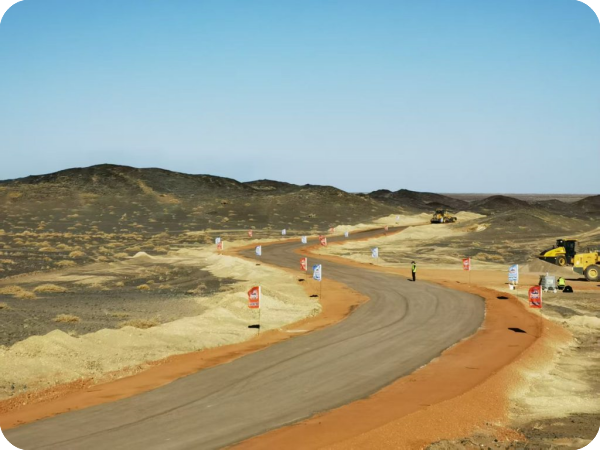
The Haolaitala open-pit coal mine is located in Bayankhongor Province, Mongolia, with a designed production capacity of 5 million tonnes of coking coal per year. The transport corridor serving the mine crosses an arid, water-scarce region with no surface water system — groundwater wells and natural water bodies are the only local sources, and mining water use requires dedicated permits. Water is the scarcest production resource here.
A heavy-haul coal road built and hardened with GR flexible pavement film-forming technology. The route carries 11-axle double-trailer containerized coal haulage in long-distance, high-frequency operation, under temperatures ranging from below −30°C in winter to above +40°C in summer. The work was carried out by MiningRoad New Materials Co., Ltd.
The operating challenge
The treated route has to withstand some of the harshest duties found on heavy-haul mine roads:
Traffic is 11-axle double-trailer containerized coal haulage — a single trip transfers load to the pavement through all eleven axles at once, in continuous, high-frequency, long-distance cycles rather than occasional passes.
Winter temperatures fall below −30°C, summer temperatures exceed +40°C, and the annual temperature swing exceeds 70°C. The surface must survive both severe cold contraction and intense heat exposure.
The mine area is arid with no surface water system. Water is extremely scarce and mining use requires dedicated permits.
Wind-blown sand crosses the road year-round, stripping fines and progressively scouring the roadbed.
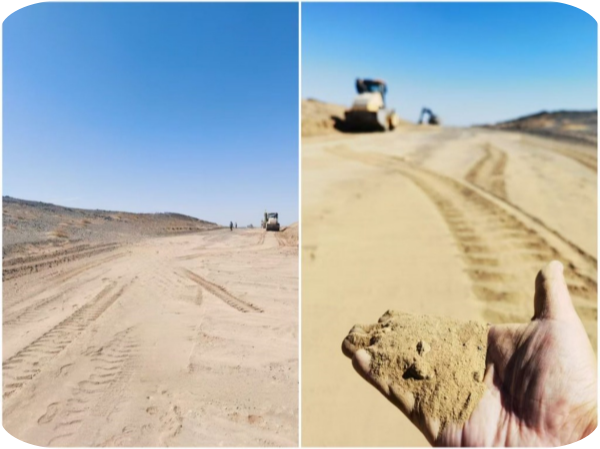
The conventional response is continuous watering. On this route that approach runs into two unavoidable limits:
Water itself is precious — water trucks have to shuttle continuously, committing water, fuel, vehicles, drivers and maintenance as recurring cost. The longer the road, the more visible the expense.
Water does not solve load bearing — it only temporarily suppresses surface dust. Once the road dries, dust returns and ruts and settlement remain. Eleven axles cannot be supported by water.
In effect, watering means paying repeatedly for a road that keeps failing, rather than building a road that carries the load.
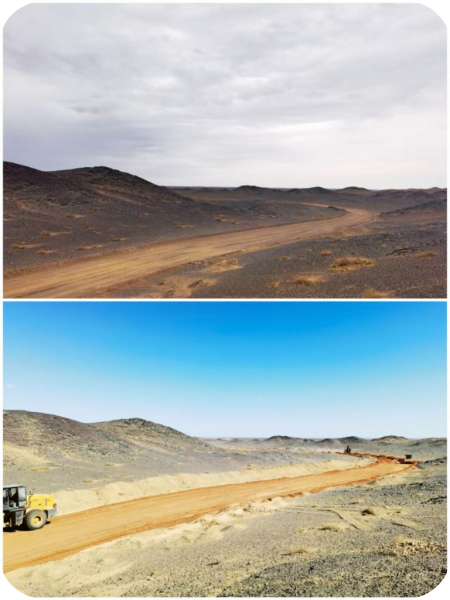
The GR solution
GR flexible pavement film-forming technology was applied as a structural treatment. Graded aggregate is mixed with the GR solution over a levelled and compacted base to form a flexible structural layer at a design film thickness of 30–40 mm. The flexible structure absorbs and buffers the stress generated by heavy loads, reducing rutting and cracking; the film layer seals out moisture and limits rain scour and wind erosion of the roadbed. Application requires temperatures above 5°C and progresses at 1 km per day, greatly shortening road closure time.
Result
After the treatment was reopened to traffic, the coal road surface became level, dense and structurally stable. The 11-axle haulage fleet now runs it as part of normal operation, the previous dust and usability problems were clearly reduced, and the mine’s reliance on continuous watering dropped noticeably. Transport cycles became more predictable and maintenance frequency fell. Under extreme temperature swings and wind-blown sand, the road holds a stable operating condition.
GR will keep tracking this stretch over the medium and long term, using real operating data to document the long-term value of flexible pavement film-forming technology on extreme heavy-haul coal roads.